- Racket Business
- Posts
- FACILITIES - SUPPLIES - PEOPLE
FACILITIES - SUPPLIES - PEOPLE
Rod Heckelman on the importance of having an active full membership. Rob Norris on clubs having an experience problem.


Rod Heckelman & Rob Norris
March 28, 2026

Table of Contents
Advertising and Promoting Your Facility
By Rod Heckelman
Take a course in advertising, and you will probably be given a general set of instructions on the process needed to promote your product. For most, that would be very helpful and likely enough to get them started promoting their product and developing a sales campaign. But not for the racket industry. The racket industry, and in particular the facility and club sector, is a completely different animal.
To start, most markets are rural or metropolitan, each with distinct ways to reach customers through advertising and promotion. In this article, we will focus primarily on common rural facilities. First, management needs to identify and focus on the local demographics. That would include income levels, median age, ease of access, and common working habits.
Your customers are likely to live within only a few miles. In most cases, they have already invested time learning a racket sport and are hoping to find a quality hosting facility. Although there will likely be some newcomers to the racket world, the majority of new members will already have a clear idea of what they want and what they are looking for. These two reasons alone require a specific game plan and approach that caters to those characteristics.
Once you have a good grasp of the variables that impact your market, you can look at a possible game plan that will be best suited for your facility. Start by assessing the local income median. Income levels can be quickly ascertained by using the Small Area Income and Poverty Estimates program, but always include the cost of housing and the cost of living. Average age is another stat that can be found through the U.S. Census Bureau by using the zip codes. Finally, ease of access. Building a facility in a more remote location may work for golf clubs, but not racket clubs. It’s often a trade-off; the more expensive the piece of land, the more likely the facility will be readily accessible. Lastly, if you live in an area where many of your potential members need to commute to work, your operating hours need to accommodate early or late usage of the facility.
The next step is understanding the best medium for reaching potential members. Obviously, the use of the internet will have the greatest impact, but only if the chosen medium focuses on local residents, such as apps or websites like Nextdoor, Peanut, ioby, and even Reddit. Remember, the market you are trying to reach is almost always within a few miles of your facility, so don’t waste your advertising budget on generic magazines or a website that focuses on a broader market. When it comes to impact with your advertising, spending should not be the key focus…intelligent and effective targeting should be the key focus.
Next step, creating your “Welcome Wagon,” otherwise known as your sales department. Most buyers will make their decision on their first visit to your facility. Will you have someone there who will be able to process that sale, or will they be referred to someone else, a practice that does not fare well when trying to close a sale? Do you have a trained sales staff? Trained means that they understand how to properly read a potential member’s intent and needs. In the club business, the best salespeople are those who know what the facility provides, often because they use the facility for their own recreational needs. If they can quickly find out what that potential member is looking for, they can immediately provide information that pertains to the exact future use and needs of the buyer.

One of the most common mistakes made in sales is initially providing a tour of the entire facility. The right approach is to first find out what their interest are and then show them what your facility will provide to best meet those needs. If they show sincere and emotional interest, give them a guest pass and have them use the facility right away. From that gesture, they will have a direct interactive experience, meet current members, and discover what other services the facility provides.
Most facilities will offer a sales package. The design of that sales package depends on what a facility feels is the most inviting to capture these potential new members. This will often include what a facility is willing to give away. Some clubs will provide packages that will help stimulate usage of the facility through coupons or gift certificates. Others will simply discount the initiation fee or provide temporary free dues as an incentive. Even others will provide a program where the initiation fee can be applied to any services or purchases from the Café or Pro Shop, even lessons.
Every market is different and can change from year to year. One of the most important benchmarks is the economy. Analyze the local economy to help you determine how much you need to give away to stimulate sales. One of the best barometers you can use is to analyze demand is the local real estate market. The hotter the real estate market is, the more turnover there will be in the local population. Take advantage of a hot real estate market and establish a good relationship with your local real estate agents. Provide these agents with tours of your facility or complimentary guest passes. You might even consider offering a commission that they can keep or pass on to their buyers.
Another sure-fire way to reach potential members is through organizations that already exist in your community. Churches, schools, and community services are all good sources for contacts. Every time there is a fundraiser, you should take part in it. Donate memberships to hospitals trying to raise money, schools trying to raise funds, or even other charities that have established themselves in your community. This will not only build your membership, but the P. R. for this generosity will go a long way in building your image in your community.
You can even combine these community activities by donating space in your club for these events and fundraisers. This may bring in business for your food concession and, at the same time, create exposure for your club to the community. When you do have events, make sure that you get the publicity you deserve. The more ink you can get in the local press, the better off you will be. Every time your name gets out there, you have created an opportunity to be known. Along those lines, make sure that the signs for your facility also help tell the passerby who you are and what you do. A quality sign in the front of your club can speak volumes over the years. Instead of just your name, how about symbols representing what your facility offers, or a large clock with your logo that will catch the eye of anyone driving by your facility? And of course, there is always the free P. R. you will get from shirts, hats, car window visors, even a car license plate trim that displays your name and maybe a motivating message. It all contributes to a quality sales program.
Remember that your effort to increase membership sales not only will define the club's growth and income but also neutralize the natural attrition that occurs. In addition, what is often undervalued is having an active full membership, which provides a better social atmosphere and additional play partners. An increased membership also contributes to a facility's income for the pro shop, food service, and professional services.
Always appreciate the marketing skills of professionals in the advertising…they know what they are doing. If you are in doubt, hire someone with a successful track record in this industry. As much as dealing with aggressive salespeople can sometimes be annoying, it’s a different story when they are on your side.
 Rod Heckelman | Rod Heckelman's career started in 1966 when he began his 5-year role as a teacher at John Gardiner’s Tennis Ranch in Carmel Valley, California. Later, he opened as the resident pro for Gardiner’s Tennis Ranch on Camelback in Scottsdale, Arizona. |
In 1976, he took over as head professional/tennis director at the Mt. Tam Racquet Club in Larkspur, California, and added the title and responsibilities of general manager in 1982. After 48 years, he retired to work exclusively in helping others in the industry.
In 2010, he was awarded “Manager of the Year” for the USPTA NorCal Division and the “Manager of the Year” at the USPTA World Conference. Rod has written several books, including “Down Your Alley” in 1993, “Playing Into the Sunset” in 2013, and most recently, “325 Ways to Play Tennis.”
He also produced the “Facility Manager’s Manual” and the “Business Handbook for Tennis Pros,” which is distributed by the TIA.
Clubs Don’t Have a Tennis Problem, They Have an Experience Problem
By Rob Norris
Something I’ve noticed over the years, being around tennis clubs, is how easy it is to miss what’s actually going on.
From the outside, everything can look healthy. Sessions are running, courts are busy, players are turning up. It feels like things are working, but then you look a little closer over time… and you start to see the pattern.
A few players stop coming.
Some lose interest.
New ones replace them.
And it just keeps repeating.
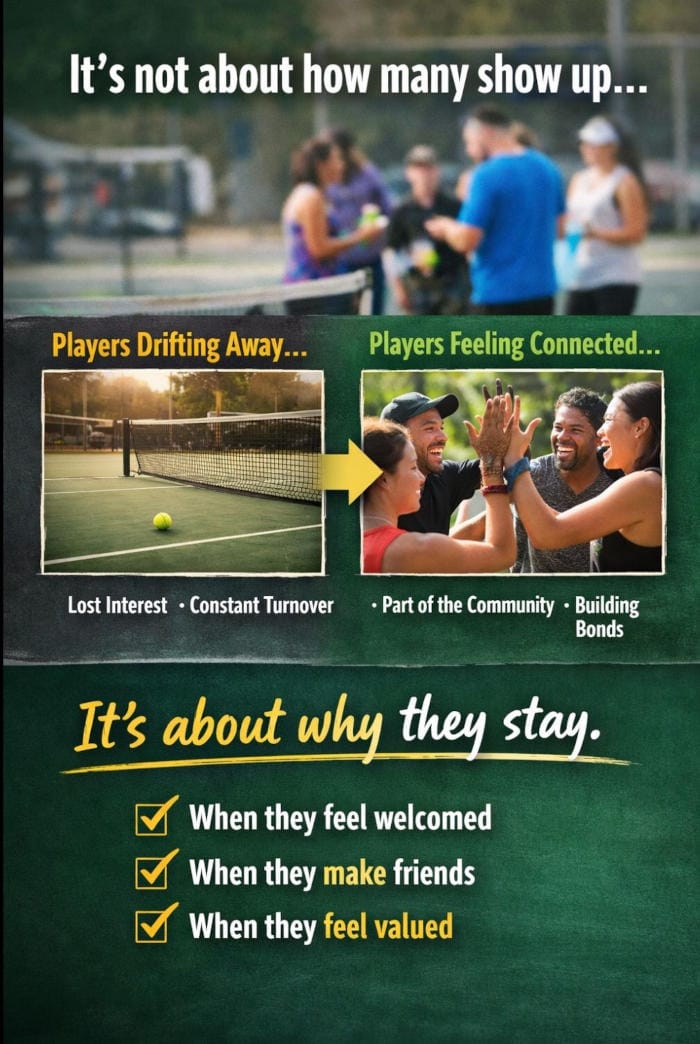
It’s not dramatic enough to raise alarm, but it’s constant. And that’s where most clubs get stuck without realising why. The natural response is to push for more. More marketing, more sessions, more players through the door. But that never really fixes it. It just keeps the cycle going.
What I’ve found is the clubs that actually grow don’t just look at how many people show up. They pay attention to how people behave.
Who stays behind to talk.
Who starts bringing friends.
Who slowly becomes less engaged before they disappear.
Those small things tell you everything because people don’t just leave suddenly. They drift, and that drift usually has very little to do with the quality of coaching. It’s more about whether they feel connected, comfortable, and part of something.
I’ve seen great coaching lose players, and average sessions keep them. That used to confuse me, but it makes sense when you look at it this way. If it feels like just another session, people come and go. If it feels like somewhere they belong, they stay.
That’s the difference I keep seeing, and once you start noticing it, you realise growth isn’t really about getting more players in. It’s about giving them a reason not to leave.
 | Rob Norris is an entrepreneur, coach development leader, and performance strategist with a proven track record of building successful programmes and developing people across the tennis, health, and wellness sectors. He specialises in designing and delivering high-impact coach education, raising standards, and creating environments where both people and performance thrive. |
With a strong focus on sustainable growth, Rob combines strategic thinking with a practical, results-driven approach. His work centres on helping coaches, athletes, and organisations reach their full potential.
Rob resides near Southampton in the United Kingdom and can be reached at [email protected] or through his LinkedIn page.