- Racket Business
- Posts
- FACILITIES - SUPPLIES - PEOPLE
FACILITIES - SUPPLIES - PEOPLE
Heckelman on the best first response in an awkward situation + LinkedIn Gold

Rod Heckelman
April 21, 2026

Table of Contents
That Very Important First Response
By Rod Heckelman
A father enters the men’s locker room with his five-year-old daughter. He has come to the club with his young daughter and is not comfortable having her go to the women’s locker room on her own. At the same time, several men in the locker room are also uncomfortable undressing in front of this young child. One of the gentlemen charges out of the locker room, demanding that the club staff immediately remove this man and his daughter from the locker room. Not a comfortable situation for anyone. What happens in the next few minutes is indicative of how important it is to approach a problem properly by choosing the best first response.
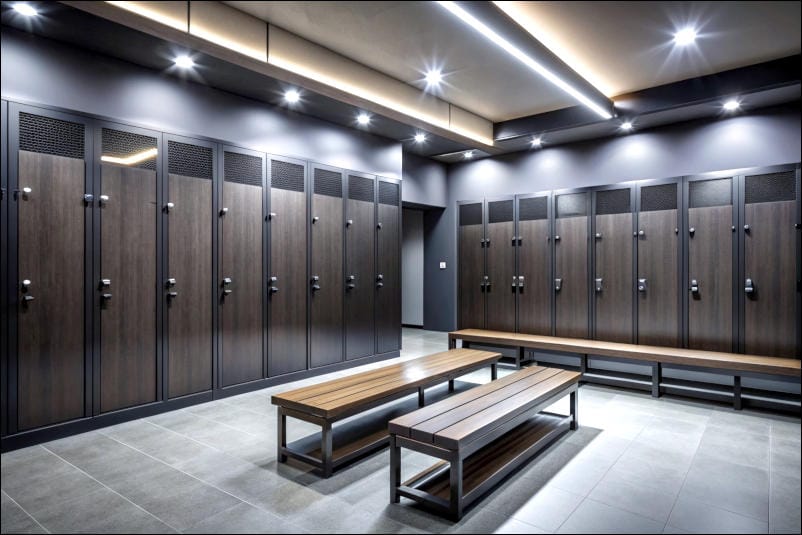
Let’s review three possible scenarios: First, your employee reacts to the complaint by immediately going into the locker room and addressing the father. They inform the father that he cannot bring his daughter into that area, and he and his daughter will have to leave. The father, like most parents, reacts defensively by accusing the club of not providing adequate services for families and proposes that if he is forced to be separated from his daughter and something happens to her, he will hold the club responsible.
Okay, second scenario. The employee tries to pacify the complaining member by pleading the father’s case or expounding on the many challenges parenting encounters, which only infuriates the member more. He then capitulates to the complaining member and goes into the locker room to try to appease the father. He gently and diplomatically explains to the father how a situation like this can be uncomfortable for other members. He explains how some members may not feel comfortable in a locker room setting with a very young girl. The father then responds basically the same as the first scenario, except not quite as angrily. Nice try, but same results, with the only difference being that now both of the members are unhappy.
A good example illustrating how important the first response is to a very awkward situation.
Finally, the third scenario. Because the employee has been prepared properly through instruction and situational training, he responds to the complaining member, “I’ll take care of that right away, thank you for bringing it to our attention.” He then goes into the locker room and approaches the father by asking him, “Can we help you out here. We have a woman on staff who would be more than happy to escort or supervise your daughter to the women’s locker room, and just so you know, you are more than welcome to approach us at the Reception Desk if you are ever in need of this service in the future.” He might even add, if applicable, “We also have a unisex bathroom out by the pool that you are welcome to use.” The father hesitates, then responds, “Okay, great, I’ll bring her out to meet your female employee.” Fairy tale ending, maybe, but a good example illustrating how important the first response is to a very awkward situation.
Most conflicts and issues evolve from one of three sources: Member dissatisfaction with an employee, conflict with other members, or disagreement with the facilities' operating procedures. Let’s start with the first problem. Employees will make mistakes. They will be late for appointments, say the wrong thing at the wrong time, or err, not knowing what to do. Although a manager will train their staff as much as possible, there will always be slip-ups. One of the best ways to avoid these mistakes is via situational training in addition to any Operation Manuals.
As a manager, never start off responding to the customer by agreeing that the employee has made a mistake. You may think you are endearing yourself to the customer by taking their side, but you are also indirectly telling them that you have failed to manage that employee, which hints to that client that this issue may come up again.

Reprimanding the employee at that moment is also not the right reaction. The member will lose trust in the employee, and the employee will lose trust in you. Think about it. What does the customer want? He wants a resolution. Act on their complaint and take charge. “Let’s get this resolved right away,” is a good answer when possible, or “I’m going to confer with (name of employee) to prevent this from happening again.” It’s important to use the employee’s name to begin to bridge the gap that this rift might have created. You don’t need to make excuses or drag out the situation with a lengthy story trying to appease that member; address the situation proactively and quickly resolve the confrontation.
When two members collide, it can get ugly very quickly. If you take sides, you will only be launching a prolonged argument. Trying to find out who is right or wrong is a waste of time and will prolong the argument and continue to create an uncomfortable environment for anyone present. Step in and take charge. “Let’s see what we can do to make this work for both of you.” Or, “Let’s find out what we can do that will make both of you happy.” If you can, separate the members as soon as possible. There is often no winner or loser in these situations, so the best thing is to calm down the situation and let the facility return to operating as usual. When it’s all said and done, document what happened, and see if further similar conflicts can be avoided. Also, avoid any unnecessary aftermath comments; gossip can spread quickly in clubs where members socially interact.
When two members collide, it can get ugly very quickly.
The most frequent complaints will be concerning the club’s policies and rules. The temperature of the pool or steam room is too cold or too hot, the music in the fitness area is too loud or not the right type, or there should be more supervision in some area of the club. The list goes on. Most of the club rules have evolved over the years and reflect the daily interaction of the membership. A manager who reacts too quickly to a “squeaky wheel” will eventually find themself under another one. The basic idea that you can’t please them all is a nice premise, but let’s take it one step further. Instead of “you can’t please them all,” how about, “I’ve looked into it and have found what works best for most.” Think about that answer. How can a member argue with that? It says it all. It says that you have researched the issue, that you’ve taken charge, and you are doing what is best for most members. You can even add, “Now that you have brought that to my attention, I’m going to look into it.” Having committed yourself, remember to follow up with a letter, e-mail, or further personal interaction to relay your findings.
Earlier, we suggested situational training. It is extremely helpful to educate and train your employees through quizzes or tests, and to recreate incidents that have taken place. This type of training will not only create a more lasting impact on your employees, but it can also make the meetings more fun and interactive. Take advantage of these meetings and encourage interaction and discussion, along with inviting suggestions from the staff. Always accept the possibility that they may provide new ideas and quality responses.
Finally, when training any employee, seek out how they best interact with people and allow them to find a response that is both acceptable and comfortable for them. This will create a much more comfortable work environment when you allow them to discover their individual method of communicating and not force them to mimic you or quote from a manual. A natural response can ultimately be much more effective and will help foster an environment that provides a relaxed interaction between staff and customers.
The interaction between the manager and the staff sets the tone for the entire facility.
The job of managing can be far-reaching and very complex. Managers have a choice of making their jobs simpler, which can usually be discovered through proper training and oversight. Keep in mind that the interaction between the manager and the staff sets the tone for the entire facility. This is why the first words that come from an employee or manager are a key ingredient in reaching that goal. They say that first impressions last forever; this could also be true of first responses.
Rod Heckelman
 Rod Heckelman | Rod Heckelman's career started in 1966 when he began his 5-year role as a teacher at John Gardiner’s Tennis Ranch in Carmel Valley, California. Later he opened as the resident pro for Gardiner’s Tennis Ranch on Camelback in Scottsdale, Arizona. |
In 1976, he took over as head professional/tennis director at the Mt. Tam Racquet Club in Larkspur, California, and added the title and responsibilities of general manager in 1982. After 48 years, he retired to work exclusively in helping others in the industry.
In 2010, he was awarded “Manager of the Year” for the USPTA NorCal Division and the “Manager of the Year” at the USPTA World Conference. Rod has written several books, including “Down Your Alley” in 1993, “Playing Into the Sunset” in 2013, and most recently, “325 Ways to Play Tennis.”
He also produced the “Facility Manager’s Manual” and the “Business Handbook for Tennis Pros,” which is distributed by the TIA.
by Bruce Allen Hartrich

 |  |

Bruce Allen Hartrich is the founder of a family of racquet sports and private club technology platforms serving tennis clubs, pickleball facilities, and full-service country clubs across the United States.
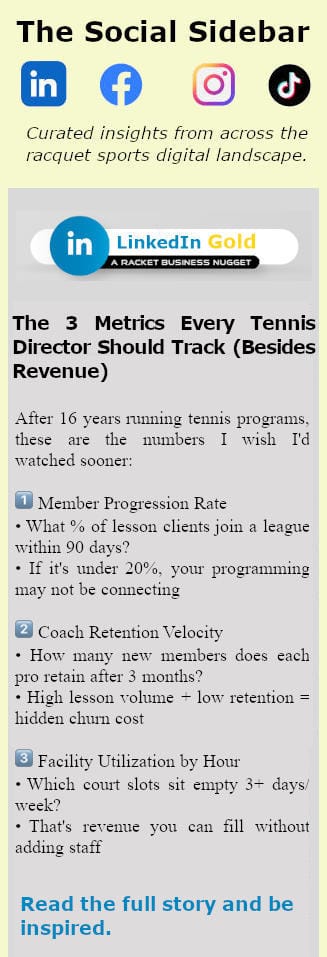
Social Sidebar: LinkedIn Gold