- Racket Business
- Posts
- High School Tennis – Pathway to Tennis for a Lifetime
High School Tennis – Pathway to Tennis for a Lifetime
Gary Horvath on the excitement to see an increase in the number of boys’ and girls’ tennis programs and overall participation.

Gary Horvath
January 31, 2026

High School Tennis – Pathway to Tennis for a Lifetime
Overview
High school tennis is an integral part of a complex system of organizations that comprise the tennis industry. Specifically, young athletes are provided with opportunities to learn life skills in a tennis setting when they play high school tennis.
It also puts them on a pathway to tennis for a lifetime.
In addition, many high school facilities are available for use by local communities. An industry study reports that over two-thirds of tennis players enjoy their favorite sport at parks and recreation facilities, schools, colleges, and courts in residential areas.
The National Federation of State High School Associations (NFHS) recently reported that during the 2024-2025 season, 363,388 high school athletes participated in its boys’ and girls’ tennis programs. There were 10,373 boys' programs and 12,175 girls’ programs. NFHS High School tennis is the largest junior tennis program in the United States. By comparison, the US Tennis Association website states that its junior program (for players ages 10 through 18) serves only about 100,000 participants annually.
NFHS Sports Programs
NFHS is a sports and activity organization. It oversees about 70 high school sports ranging from rodeo to pickleball. Tennis is one of those sports. In addition, approximately 10,000 athletes participate in adapted programs, and 70,000 are in unified programs.
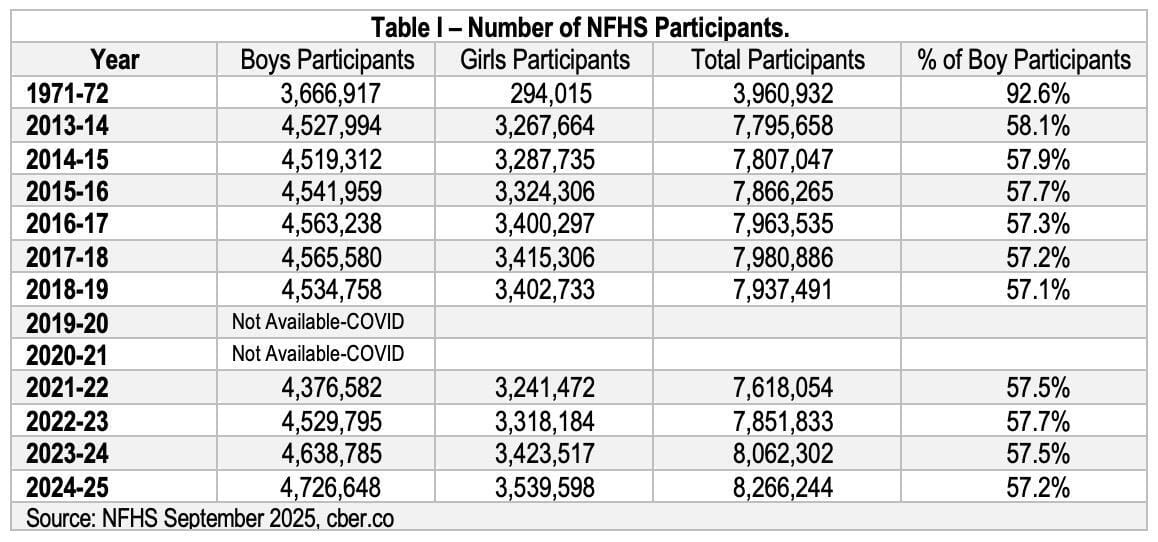
During the 2024-25 season, there were almost 8.3 million participants in NFHS programs (participants may play in multiple sports). About 57%, or 4.7 million, were boys, and 3.5 million were girls. This past year, the number of participants increased by 2.5%, with a 3.4% increase for girls and a 1.9% increase for boys.
NFHS Tennis Participation
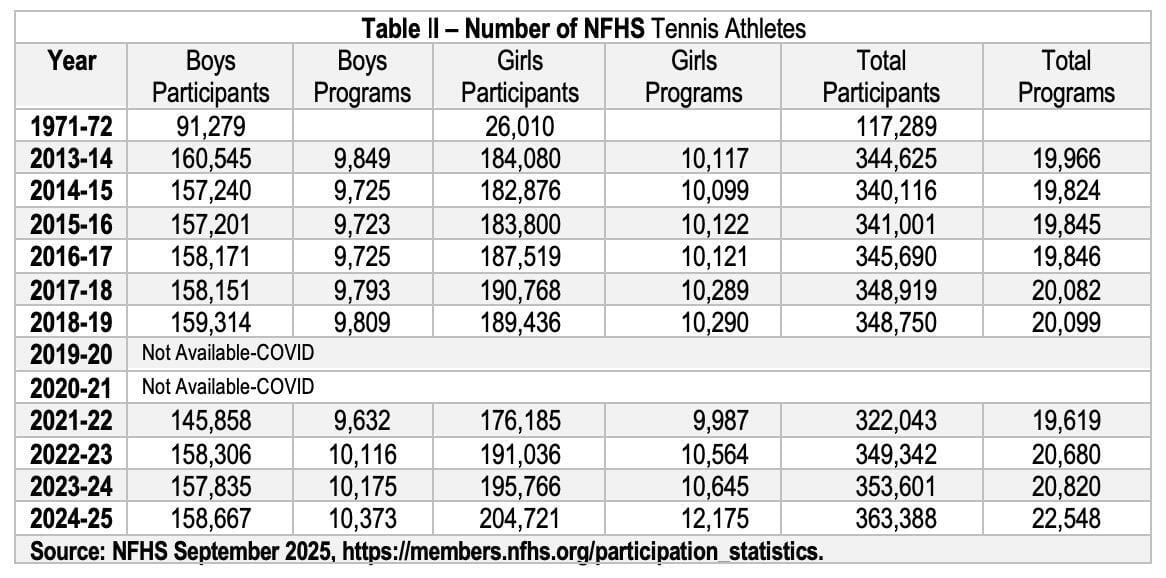
For the season 1971-72 (Table II), there were 91,279 boys’ participants and only 26,010 girls. In subsequent years, the number of girls’ tennis participants increased rapidly after the adoption of Title IX.
The number of boy participants peaked in 2018-19 at 159,314. Participation dropped off drastically due to COVID and has not returned to its peak. During the 2024-25 season, there were 10,373 programs and 158,667 participants. Unfortunately, there are fewer participants than during the 2018-19 season, but the number of teams is up by 4.6%.
The story was even more positive for the girls. During the 2024-25 season, 204,721 girls played. This was an increase of 15,285 participants (8.1%) from the 2018-19 season.
In 2024-25, total participation was 363,388, an increase of 14,638 participants (4.2%). The total number of programs was 22,548. This was an increase of 2,449 programs (12.1%).
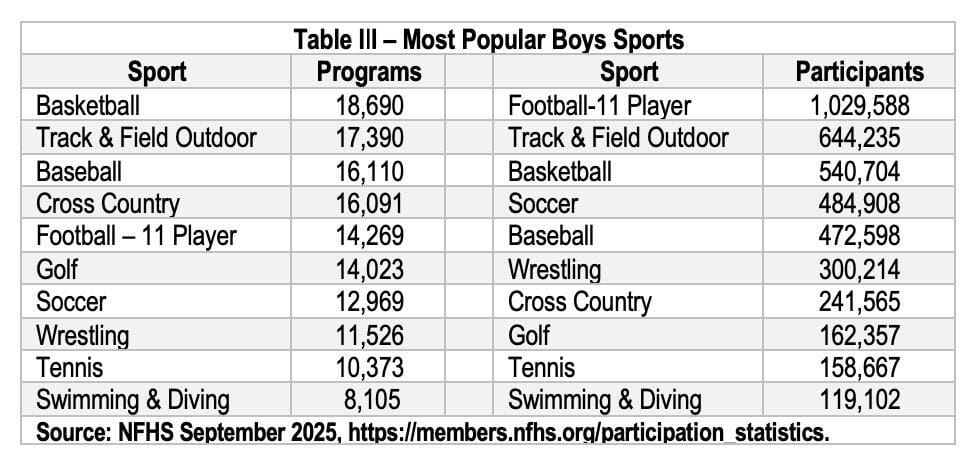
The growth of tennis is impressive, but there is stiff competition from other sports. The most popular boys’ sports are football, track and field (outdoor), basketball, soccer, and baseball. Golf and tennis are the eighth and ninth most popular sports (participation). Tennis was ranked ninth in terms of the number of programs.
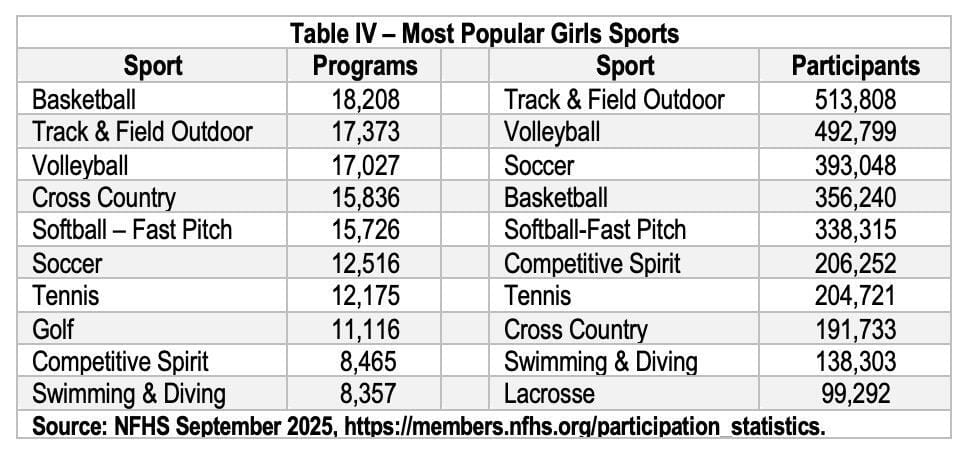
The most popular girls’ sports are track and field (outdoor), volleyball, soccer, basketball, and softball. Tennis is the seventh most popular girls’ sport (participation). Tennis and golf have the 7th and 8th most programs.
Growth of High School Sports Since 2018 – 2019 Season
Table V shows the top twenty high school sports based on 2024-25 participation. Over half of total participation is in the top five sports: track and field (outdoor), football (11), basketball, soccer, and volleyball. Between 2018-2019, half of these sports increased their participation and half decreased.
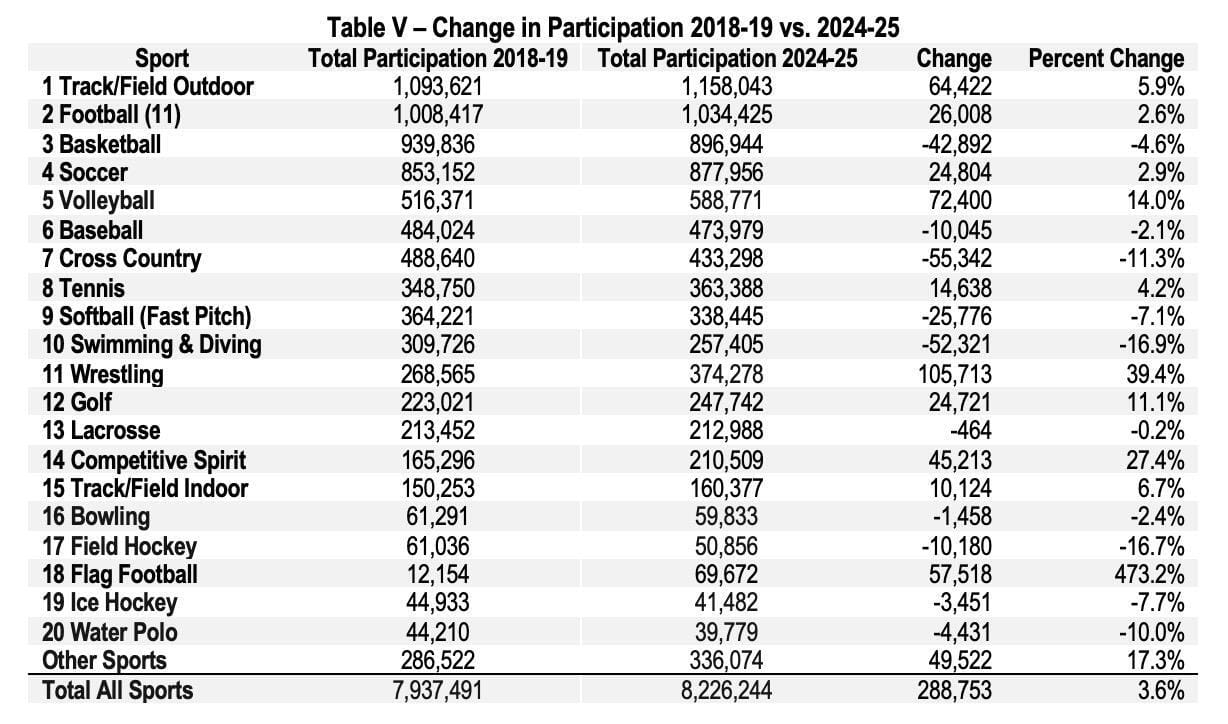
The sports with the largest gains were:
Wrestling +105,713
Volleyball +72,400
Track/Field Outdoor +64,422
Flag Football +57,518
Competitive Spirit +45,213.
Tennis added 14,638 participants over this period. Other sports, not listed, that are increasing participation include weightlifting, dance, and e-sports. Each has more than 30,000 participants.
The sports that showed the largest decrease in participation were:
Cross Country -55,342
Swimming and Diving -52,321
Basketball -42,892
Softball (Fast Pitch) -25,766
Baseball -10,045.
In other words, athletes, or their schools, have lost interest in some established traditional sports. The tennis industry should take notice.
Takeaways
Participation in high school sports has increased in a challenging environment after the pandemic downturn. It is particularly exciting to see an increase in the number of boys’ and girls’ tennis programs and overall participation.
The tennis industry must remember the strengths of high school tennis.
It is an individual sport that can be played in a team setting.
Athletes have an opportunity to improve their tennis skills and continue learning, outside the classroom, in the company of their friends and fellow students.
High school tennis athletes have access to the pathway to tennis for a lifetime.
The list goes on at length.
Thanks to the players, coaches, administrators, fans, spectators, parents, and the NFHS network for making high school tennis successful! See you on the courts (In Colorado, the high school girls’ season is right around the corner).
 Gary Horvath | Gary Horvath is a USPTA master pro, founder, and past president of the USA Professional Platform Tennis Association, a charter member of PPTR, a certified coach with USA Volleyball, and a long-standing member of the Wilson Advisory Staff. His experience as a tennis pro has covered the entire spectrum from grassroots to college tennis. |
In addition, Gary Horvath has conducted extensive business and economic research that has largely supported the state of Colorado's economic development efforts.