- Racket Business
- Posts
- In the Trenches: Connection Is the New Competition - Why Adults Don’t Quit Because of Their Backhand
In the Trenches: Connection Is the New Competition - Why Adults Don’t Quit Because of Their Backhand
Susan Nardi on Why Adults Really Drop Out

Susan Nardi
February 21, 2026

Adults don’t quit tennis because of their backhand or serve.
They quit because they don’t belong.
Last week, as I finished teaching an Adult Advanced Beginner class, one of my players, Silva—a 50-year-old business professional and mom—walked onto the court a few minutes early for LA LiveBall class. She looked tired. Before we even started warming up, she said, almost in passing:
“It’s been a long, lonely week. All I could think about was how I needed to come to tennis to see friends. It’s how I decompress and have fun.”
That stopped me.
Not because it was dramatic. But because it was honest.
And because I hear some version of that every single week.
What We Think We’re Selling
As an industry, we believe we’re selling:
• Stroke production
• Strategy
• Cardio
• Competition
• Ratings and pathways
But what many adults are actually buying is:
• Connection
• Belonging
• Stress relief
• Identity
• Community
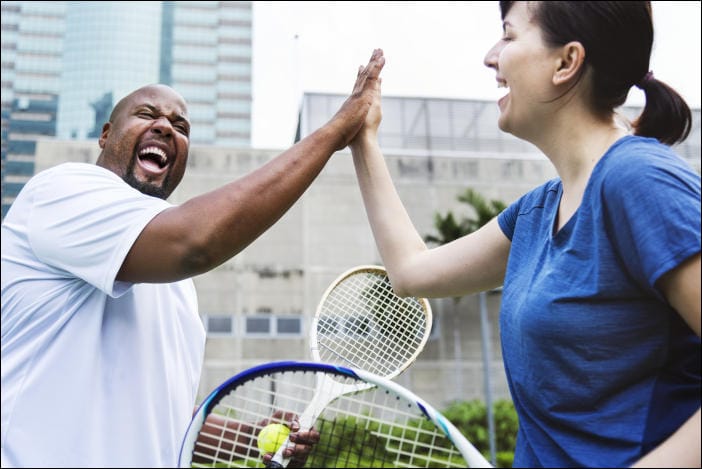
When I reviewed what we covered at the end of that class—serves, movement patterns, point construction—I asked what stood out most.
The answers weren’t technical.
“This is the highlight of my week.”
“Playing is finally fun now.”
“I just moved here, and I now have seven new friends.”
The class ranged from 25 to 70 years old. Different careers. Different backgrounds. Different skill levels.
The common thread wasn’t improvement.
It was joy.
It was connection.
It was community.
The Epidemic We’re Not Talking About on Court
The U.S. Surgeon General has declared loneliness a public health crisis. Research links chronic loneliness to increased risk of heart disease, anxiety, depression, and even premature mortality. The Surgeon General's study compared the health impact of 1 day of loneliness to smoking 15 cigarettes a day or 6 alcoholic drinks.
Modern medicine has become very good at increasing lifespan.
We are not nearly as good at improving quality of life.
And this is where racquet sports hold extraordinary power.
Because tennis and pickleball are not solitary fitness activities. They are inherently relational. You need someone across the net. You rotate. You partner. You talk between points. You gather after play.
Our courts are built for connection.
The question is: are our programs?

Why Adults Really Drop Out
In my experience, adults rarely quit because they can’t master a topspin backhand.
They quit because:
• They never feel integrated.
• They don’t know anyone off the court.
• They feel intimidated.
• They feel invisible.
• They don’t feel missed when they skip a week.
Belonging is retention.
And retention is business.
We spend enormous energy trying to acquire new players. Yet we often neglect to intentionally design the social architecture that keeps them.
Community does not happen by accident.
It must be built.
From Coaching Skills to Designing Belonging
This realization is what led me and my colleagues to create HEAL-ACTS: Helping Ease Adult Loneliness – Adults Connecting Through Sports.
It wasn’t born out of a grant proposal or a business plan.
It was born from observation and personal experiences.
I watched adults arrive to class carrying the invisible weight of demanding jobs, caregiving, transitions, relocations, divorce, aging parents, and quiet isolation.
And then I watched what happened when they played together consistently in a structured, welcoming environment.
They stayed after class.
They exchanged numbers.
They met for coffee.
They formed doubles groups.
They checked in on each other.
They laughed.
They decompressed.
They built something bigger than their forehands.
HEAL-ACTS formalizes what great coaches intuitively know: play is not childish. It is necessary.
Connection is not a bonus feature. It is the product.

Connection Is the New Competition
Competition will always have its place. Ratings matter. Pathways matter. Development matters.
But for the adult market—which represents an enormous opportunity in our industry—connection is the new competition.
Facilities and coaches that understand this will win.
Program that!
For more information on the HEAL-ACTS Foundation.
Go to our website www.healacts.org, follow us on social media, or reach out to me.
 Susan Nardi | Susan Nardi is a certified tennis professional specializing in creating and expanding innovative development programs for juniors 10 and under as well as developing high-performance players. She creates development programs that ignite children’s passion for the sport and also give them a solid foundation in playing the game. |
Her company, Mommy, Daddy and Me Tennis, has produced dynamic videos and delivers staff training to help clubs train their staff to deliver this successful curriculum.
Susan played college tennis at Elon College (NC) and Radford University (VA). She was an assistant coach at Virginia Tech, Caltech, and Irvine Valley Community College.
She coached at the Van der Meer World Training Center on Hilton Head Island, SC, working with high-performance players. Coach Nardi was the head coach at Capistrano Valley High School, where numerous players went on to play college tennis on scholarship. She is the only female to be the head coach of the All-Army Tennis Team.
Susan F. Nardi
President & Fun Engineer
Rhino Crash Sports Group, Inc.
Website: https://playtennis.usta.com/RhinoCrashSportsGroup
2021 Positive Coaching Alliance National Double-Goal Coach
https://youtu.be/XgjTJ7WRuic