- Racket Business
- Posts
- Let Us In
Let Us In
Wisdoms from a Volleyball Coach Totally Applicable to Racquet Sports

Loren Anderson
January 25, 2026
How youth sports was promised immortality—and quietly gave up its pulse
I recently watched the 2025 film Sinners. I was struck not just by the performances, the cinematography, and the soundtrack—though all are exceptional—but by the metaphor at the heart of the story. The film uses vampirism to explore extraction: how something living can be preserved, circulated, and celebrated… while being slowly drained of its ownership, context, and breath.
What the Monsters Are Really Eating
Nothing in Sinners is taken by force.
That’s the first thing the film teaches you, if you’re paying attention.
The vampires aren’t the story.
They’re the mechanism.
Beneath the surface, the film is less about horror than extraction—about how Black music can be preserved and elevated under the promise of immortality, while being quietly severed from the people and places that gave it life. The music isn’t destroyed. It’s protected. Archived. Made permanent.
It just stops belonging to those who made it.
That’s why the metaphor works. Vampires don’t conquer through violence. They offer safety, amplification, and continuity. They promise survival—at a price that isn’t visible until much later.
Once you see that pattern, it becomes difficult not to notice it elsewhere. Especially in systems that claim to “save” something by stabilizing it, scaling it, and turning it into a pathway.
This article borrows that lens.
Not to talk about monsters.
But to talk about what happens when living systems are preserved instead of cared for—and why the invitation almost always sounds reasonable at first.
Listen closely.
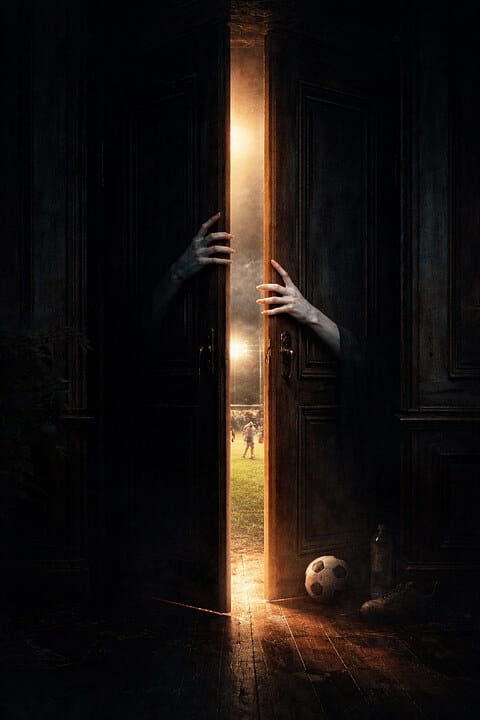
Come Inside
No one forces the door open.
That’s the part people miss.
The voice comes from the threshold—calm, patient, reasonable.
Let us in.
We’ll take it from here.
Youth sports doesn’t begin as extraction.
It begins as reassurance.
You’re not wrong for wanting more for your kid.
You’re not foolish for worrying they’ll fall behind.
You’re not imagining how competitive everything has become.
Let us in—and we’ll take it from here.
Preservation Is Not Care
The vampires don’t destroy the music.
They preserve it.
They record it. Curate it. Refine it.
They keep it recognizable—just not rooted.
What’s lost isn’t the sound.
It’s the relationship.
Preservation feels like love when you’re afraid of loss. But care requires proximity. Context. Responsibility over time. Preservation only requires control.
Youth sports followed the same arc.
We didn’t protect play.
We standardized it.
The Cost of Certainty
Living systems are uncomfortable.
They’re unpredictable. Uneven. Slow in places, explosive in others.
So we traded them for certainty.
Clear pathways.
Age-based ladders.
Rankings, metrics, calendars planned years in advance.
Certainty soothes anxiety—especially adult anxiety.
But certainty always sends the bill later.
Nothing Dies All at Once
Joy doesn’t disappear dramatically.
It fades in increments:
When play becomes preparation
When preparation becomes performance
When performance becomes identity
No alarms sound.
Kids are still playing.
Parents are still clapping.
The lights are still on.
But circulation slows.
Breath shortens.
The room gets quieter in ways you don’t notice until you leave it.
What Survives the Feeding
What survives isn’t what matters most.
What survives is what feeds the system:
Volume
Compliance
Visibility
Scalability
What struggles to survive:
Late bloomers
Multi-sport kids
Curious players
Coaches who value learning over leverage
The game remains.
The music was never destroyed. It was kept alive.
Who Opens the Door
In Sinners, the vampires can’t cross the threshold on their own.
That rule matters.
What matters more is who finally invites them in.
It isn’t a musician chasing fame.
It isn’t someone hungry for power.
It’s the Asian store owner—grieving, isolated, recently widowed.
She opens the door not out of greed, but out of loss.
This is where the metaphor sharpens.
Extraction systems don’t prey on ambition first.
They prey on wounds.
She has already lost something irreplaceable. Stability isn’t an abstract value—it’s survival. So when the vampires arrive offering order, permanence, and protection, the invitation doesn’t feel like betrayal.
It feels like relief.
That’s the cruelty of the system: the door is usually opened by someone who cannot afford another loss.
The House That Teaches You Its Rules
Once the door is open, the system doesn’t need to force anything.
It settles in.
Parents learn what to say.
Coaches learn what to expect.
Kids learn what earns approval.
“This is just how it works.”
“This is the level.”
“This is what it takes.”
And once they’re inside, nothing has to be enforced.
They thank you for letting them in—
and slowly teach everyone how to live in a house that no longer feels like theirs.
Good People, Bad Incentives
Most people inside this system are not greedy.
They’re tired.
They’re scared.
They’re trying to do right by kids they love.
But systems don’t run on intention.
They run on incentives.
And when incentives reward extraction, even good people extract.
Not because they want to.
Because the system makes it feel unavoidable.
Scale Is Not Love
Growth gets mistaken for health.
More teams.
More events.
More exposure.
But living systems don’t thrive by growing endlessly.
They thrive by regulating.
Love is local.
Care is specific.
Joy doesn’t scale cleanly.
And once something has been converted into a product, it starts asking the same question, over and over:
How do we make it bigger?
Not: How do we keep it alive?
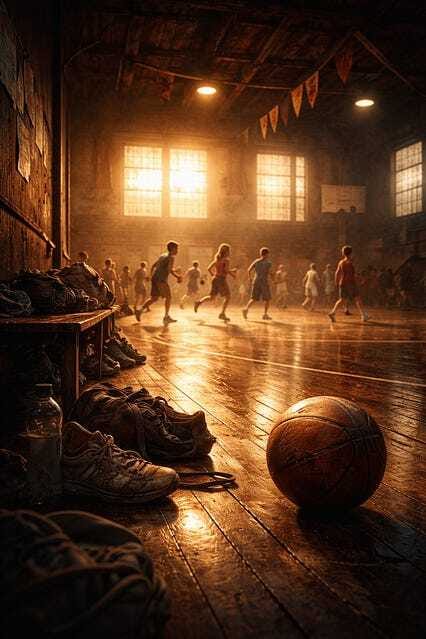
Choosing Enough
Resistance isn’t loud.
It’s choosing not to open the door again.
It’s saying no when yes would be easier.
It’s keeping the threshold meaningful.
It’s staying smaller than you could be.
It’s letting some opportunities pass without treating that as failure.
It’s choosing enough.
Not because it’s optimal.
Because it’s humane.
The Hunger That Never Ends
Extraction systems are never satisfied.
There is always:
Another season
Another tier
Another promise just out of reach
Immortality is always one payment away.
That’s how hunger works.
And once the house has been rearranged around hunger, you don’t notice it as hunger anymore.
You just call it “normal.”
Coda: Still Breathing
Youth sports hasn’t disappeared.
It hasn’t been taken.
It’s been protected. Organized. Optimized.
Kept alive in a way that looks like care from a distance.
But living things aren’t sustained by permanence.
They’re sustained by circulation.
In some places, the air still moves.
The play still wanders.
The game still belongs to the people inside it.
And the clearest sign something is still alive?
No one has to ask permission to breathe.
 | About Loren Anderson on his Substack platform: “Exploring modern volleyball coaching through curiosity, adaptability, and innovative methods. Dive into strategies, player development, and fresh perspectives inspired by ecological dynamics, motivational interviewing, and more.” Loren is a volleyball coach who owns the Tualatin Valley Volleyball Club in Hillsboro, Oregon. |