- Racket Business
- Posts
- TYPTI: New Sport or a Touchtennis Rebrand?
TYPTI: New Sport or a Touchtennis Rebrand?
TYPTI represents another entry in the growing ecosystem of racquet sports designed to lower the barrier to entry and get more people onto a court.

Rich Neher
January 29, 2026
The promotional TYPTI event at California Smash in El Segundo, just south of Los Angeles, was nice. I’d never been to the fabulous California Smash indoor Pickleball facility and was really surprised by how nice that facility was. Nine beautiful courts, bright and colorful, a bar, and plenty of seating areas - what an amazing place! (We need that in the San Fernando Valley!) The photo below shows the entrance.
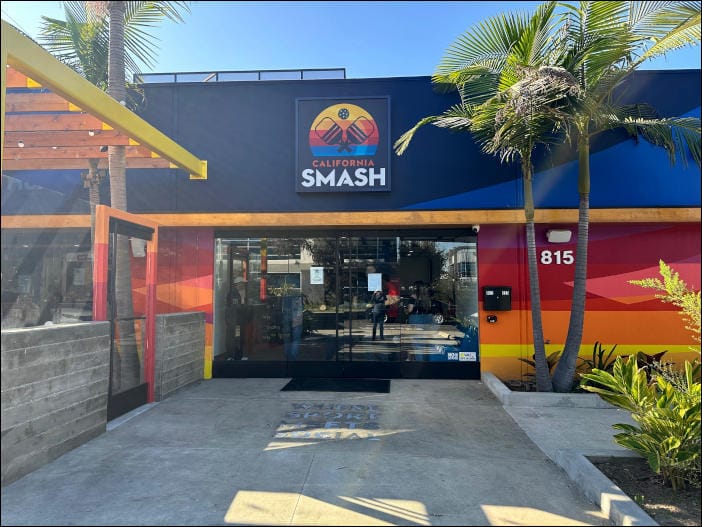
Photo: Racket Business
As expected from anything Steve Bellamy does, the event was well-organized, featuring an exhibition-style tournament, a press conference, and celebrity appearances.
The photo below shows a glimpse of the facility's interior as you enter the lobby area.
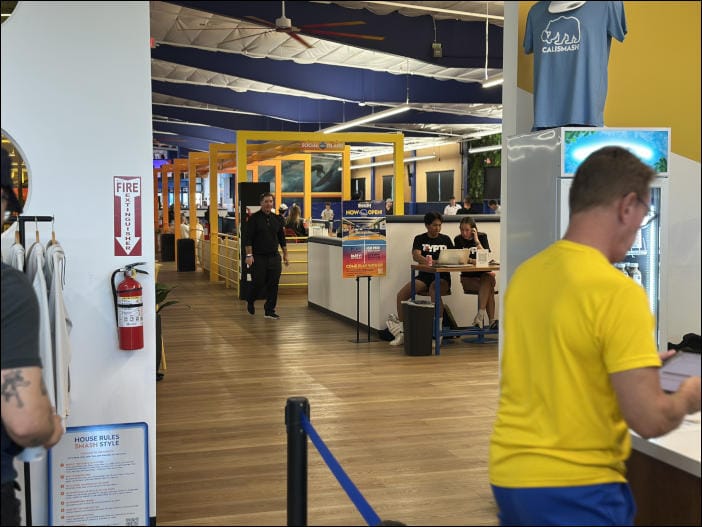
Photo: Racket Business
California Smash 360
The snippet below shows a fast 360 view of the inside of California Smash.

Steve Bellamy
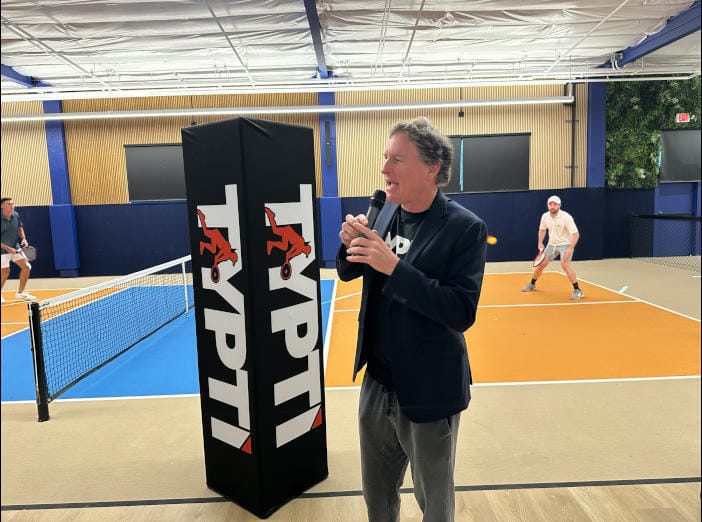
During the press conference, I asked Tennis Channel founder Steve Bellamy about the name TYPTI, which makes little sense to everyone I’ve asked. His answer: George Eastman was once asked why he named his company Kodak. He said that he was looking for a 5-letter, rather meaningless word, and Kodak came up. So, it didn’t really matter what name to choose. The story makes more sense knowing that Bellamy was the President of Kodak’s Motion Picture Entertainment division for over 10 years.
Playing TYPTI
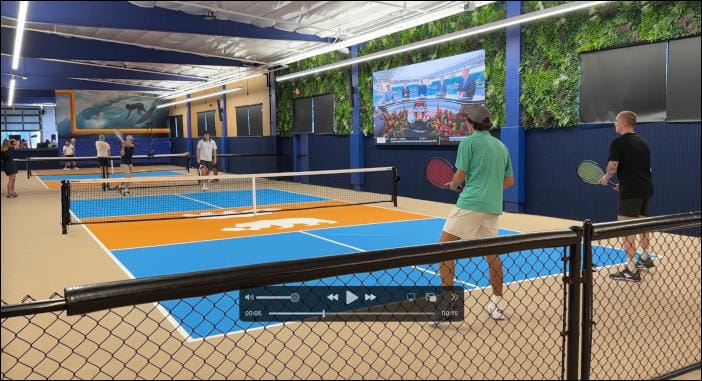
My first impression of watching TYPTI players on the Pickleball court was quite positive. It appeared this was way more fun than Pickleball. Watching those very good players made it appear that TYPTI is a little too difficult for lower-level recreational players. That may be the reason that Bellamy reportedly plans to focus on professional players and prize money tournaments right now. The snippet below shows 16 seconds of a TYPTI point.
The TYPTI Ball
Here’s what TYPTI Warehouse posted about the ball: “The 3.5-inch channeled foam ball is the result of extensive development and testing, created for the perfect gameplay experience with a focus on bounce and spin.”
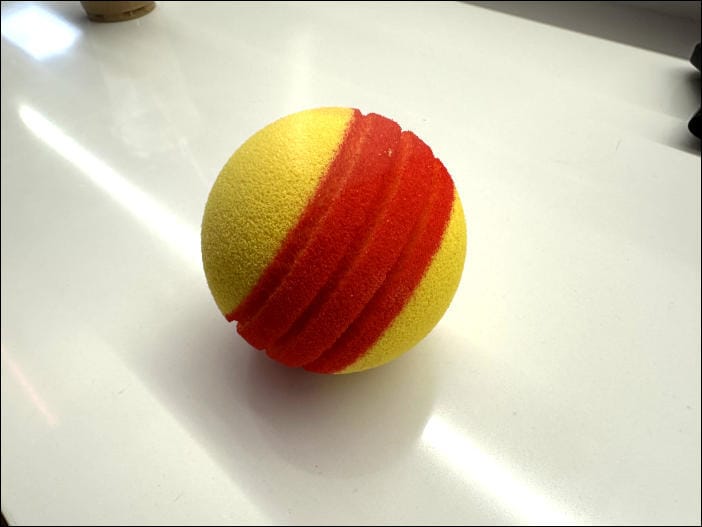
Photo: Racket Business
The TYPTI Racquet
The TYPTI racquet is a specialized 22-inch long, strung racquet, specifically engineered for use with a 3.5-inch channeled foam ball on pickleball-sized courts. The racquets are designed to bridge the gap for former tennis players and are distinct from standard tennis or pickleball equipment.
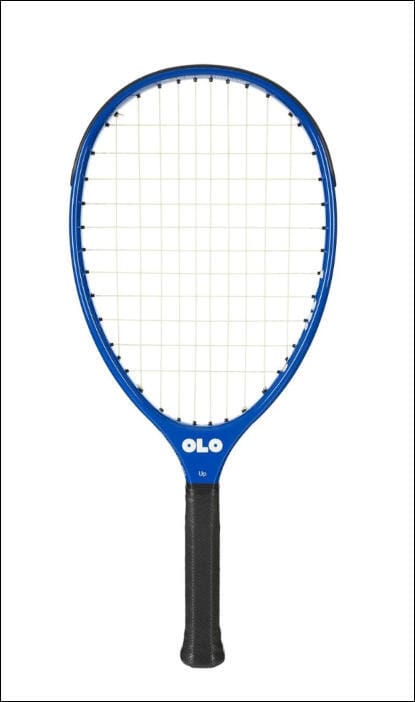
Photo: TYPTI Warehouse
Other Player in the Game of Repurposing Pickleball Space
Whispers circulated through the crowd in El Segundo that TYPTI bore a striking resemblance to touchtennis, a sport founded in 2002 by Rashid Ahmad. Questions regarding the origins of TYPTI aren't entirely unexpected; the racquet sports world often sees overlapping concepts, a pattern previously seen during the rise of LiveBall.
Lite Tennis is simply tennis played on a smaller court, like a Pickleball court, using a standard tennis racket and a proprietary foam ball.
SkyBall is played with a 21-inch racket and a foam ball on a Pickleball court.
It's getting crowded on that precious real estate called Pickleball courts.
TYPTI vs. touchtennis – Spot the Difference
To the untrained eye, these sports are identical twins. To a trademark attorney, they are "distinct intellectual properties." Here is how they stack up:
Feature | touchtennis | TYPTI |
Court Size | 40' x 20' (standard) | 44' x 20' (Standard Pickleball Court) |
Racquet | 21-inch strung racquet | 22-inch specialized strung racquet |
Ball | 3.15-inch high-density foam | 3.5-inch "channeled" foam ball |
Scoring | Short sets to 4 (Tennis style) | "Stakes Scoring" (3 consecutive points to win) |
The "Gimmick" | Only one serve; No "Let" rule | Legal body saves (including your face!) |
touchtennis Founder Rashid Ahmad chimes in
We asked Rashid for a statement regarding the crowding of Pickleball courts with touchtennis-like sports. Here is his reply:
“touchtennis has seen steady, organic growth globally and in the USA over recent years, driven by its simplicity, accessibility, and its roots in tennis itself. With over 15 years of structured development, celebrity endorsement, competition footage, data, and a clearly defined rule-set, touchtennis was designed to complement tennis – not replace it – offering clubs and players a low-cost, high-skill format that keeps people on court longer and brings new players into the game.
We have always been open to working collaboratively with the USTA to ensure innovation strengthens tennis rather than fragments it. The challenge in the US market has been less about demand and more about dilution – with multiple unaligned, lookalike formats emerging, often without history, standards, or pathway. Our view remains simple – collaboration around a proven format benefits players, coaches, clubs, and the wider tennis ecosystem far more than a crowded field of disconnected imitations.
Bear Grylls, Fernando Gonzalez, and Marcus Willis are regular players and supporters of touchtennis.”
Rashid’s mention of the USTA is significant in light of the organization's earlier rejection of Steve Bellamy’s proposal. (See “Will Bellamy succeed with TYPTI?” in last month’s Publisher’s Notes.)
The "Innovation" of Monetization
While the sport itself appears to be a direct adaptation, the marketing around TYPTI focuses heavily on its 'innovative' monetization model. However, upon closer inspection, the strategy feels less like a new invention and more like a tactical rebranding of existing club structures. By highlighting these revenue streams, the venture follows a path familiar to some industry veterans who remember the discussions surrounding the commercialization of LiveBall—a debate over whether these are new inventions or refined versions of existing play.
Unlike touchtennis, which grew as a grassroots alternative to tennis, TYPTI is launching as a high-octane commercial venture:
Celebrity Backing: Bellamy has already recruited a star-studded list of investors, including Chris Pine, JJ Abrams, and Tony Robbins, framing it as the "snowboarding of the racquet world". (Many investors are listed in this FLORIDA TENNIS article: Tennis Channel Founder Steve Bellamy Leads Iconic Investor Group to Launch New Racquet Sport TYPTI.)
Infrastructure Arbitrage: The genius—or audacity—of TYPTI is that it doesn't need new courts. It explicitly targets the tens of billions of dollars already spent on pickleball infrastructure.
Proprietary Gear: While you could play a version of this with a $25 junior tennis racquet, the official OLO TYPTI racquets retail for approximately $200.
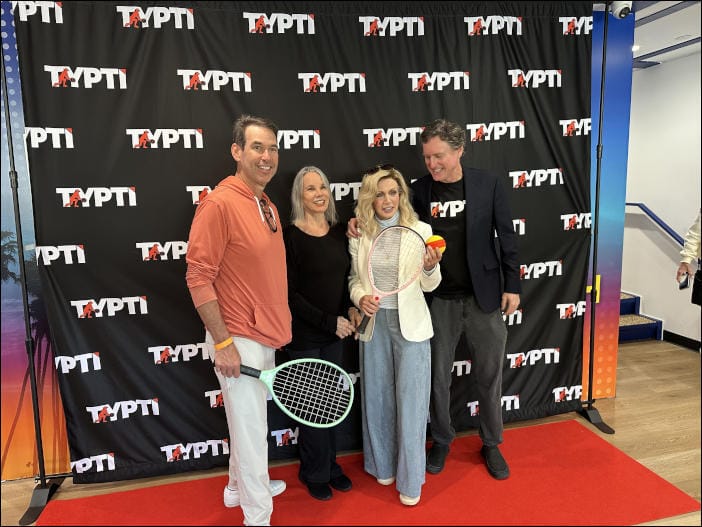
From left: Doug Allen, Barbara Herschey, Donna Mills, Steve Bellamy
The "New" Rules
To justify the "New Sport" label, TYPTI introduces a few wrinkles that lean into the casual, high-energy spirit of the game rather than traditional professional sport structures.:
Body Saves: You can use any part of your body (including your face) to keep a ball in play.
Net Continuity: If you hit the ball into the net on your side, you can keep the rally going as long as it hasn't bounced twice. using your hands, feet, or racket handle.
Stakes Scoring: Instead of 15-30-40, you win by taking three points in a row. If you are "2-Up" and lose a point, the advantage resets or swings to your opponent.
Conclusion: The Battle for the 44-Foot Rectangles
Whether TYPTI is a bold new evolution or simply the latest iteration of foam-ball racquet sports remains to be seen, but the real test won’t be in the boardroom—it’ll be on the local courts. With Bellamy positioning the sport as the "snowboarding of the racquet world," he’s counting on a younger, more athletic demographic to flock to the sport.
However, there’s a massive neon-green elephant in the room: the Pickleball Community. Will the fiercely protective pickleball community—often jokingly referred to as the 'Pickleball Mafia'—actually share their precious rectangles with people swinging full tennis strokes and diving for face-saves? Or will TYPTI find itself in a turf war where the only thing louder than the "nearly noiseless" foam ball is the argument over court time?
The boys from the popular PicklePod with Zane Navratil podcast are skeptical…

My take: Ultimately, TYPTI represents another entry in the growing ecosystem of racquet sports designed to lower the barrier to entry and get more people onto a court. That’s just my opinion. Accessibility is its greatest strength; the game can be played anywhere from a dedicated pickleball court to a backyard or a garage driveway with simple chalk lines. As the market continues to expand, we can expect a wave of similar 'touch tennis' derivatives—whether they are branded as Lite Tennis, Skyball, or Kodak. In this increasingly crowded field, the name matters less than the infrastructure behind it. The ultimate survivors will not be determined by the novelty of their rules, but by the strength of their funding and the effectiveness of their management. (And by the willingness of Pickleballers and their Ambassadors to give up court time for “intruders.”)